How AI Search Is Changing SaaS Demand Generation
AI is changing how B2B buyers discover, research and evaluate software. Potential customers are turning to AI-powered tools to understand software categories, compare solutions, explore product capabilities and identify vendors, often before speaking to a sales team as they once did.
But if you think that means traditional search is stepping aside, you’d be wrong. SaaS businesses today need to consider how traditional and AI search can work together. The focus is still on being recommended, mentioned, and accurately represented in online search, but strategies might need tweaking to ensure AI results are valued too.
Understanding how AI search is changing the landscape of the B2B buying journey, and what this means for SaaS marketing strategies, is becoming increasingly vital for service providers looking to generate demand. So, let’s look at what’s changed and how to adjust your strategy accordingly.
How AI search is changing SaaS discovery
Traditionally, B2B buyers relied on search engines like Google for SaaS discovery. They might have searched for a particular software category, browsed results, visited several sites and used comparison platforms to assess their options.
With the rise of AI search, though, this process is rapidly changing. Instead of only presenting users with SERPs filled with links to explore, AI-powered tools can generate direct answers to search queries, complete with easy-to-digest summaries from multiple sources and tailored recommendations for potential software providers meeting different requirements.
For example, a business searching for a new project management platform might ask: “What are the best project management platforms for an SME with remote teams?”
Instead of then manually researching different providers, the SaaS buyer could receive an AI-generated list of recommended platforms, alongside their key features, pricing considerations and suitability for the particular requirements mentioned in their query.
Here’s the summary generated for this query using Google’s AI Overview tool:
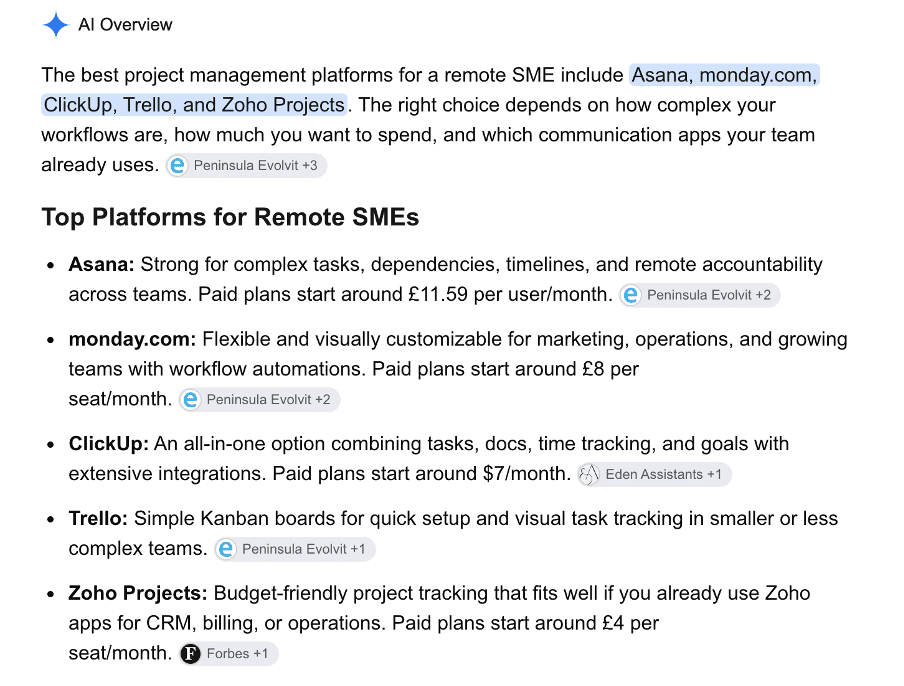
The AI tool recommends five platforms it deems best for remote-working SMEs, alongside a summary of top features, benefits and costs. Next to these, you can see a link to the sources used, allowing users to do further research.
In this example, it’s worth pointing out that the content appearing isn’t coming from the SaaS sites themselves. This highlights the distinction between traditional search visibility, which relies on how well your site ranks in SERPs, and AI search results, which draw on information from your wider digital presence.
AI can look beyond content published on your site to generate search results from all over the internet. Common sources might include:
- Review platforms
- SaaS websites
- Editorial content
- Blogs
- Industry publications
- Comparison sites
This shift presents both opportunities and challenges. While AI-powered discovery creates new ways for SaaS businesses to reach potential customers, it’s also changing how brands get their products out there and how their value is communicated. Ensuring your business is being recommended over competitors in these results is essential for bringing in the right customers.
How AI search is changing the SaaS buyer journey
The B2B buying journey once meant multiple stages of research relying on Google searches, visits to vendor sites and manual comparison. Instead, AI consolidates the entire process across each stage, helping buyers identify major business problems, explore software categories, understand product capabilities, compare features and narrow down potential vendors.
B2B buyers can use AI to identify software solutions, understand product capabilities, compare features, evaluate pricing and narrow down potential vendors before visiting a company’s website. They might even reach the purchasing stage without directly engaging with any of your site’s content.
This can have a huge impact on organic website traffic and lead attribution. AI search results can answer many informational and early-stage questions, so your site will likely see fewer clicks from discovery and informational queries. This doesn’t mean your content shouldn’t still target customers in the earlier phases of discovery, though. It just means customers might find this information somewhere else. Your sales and marketing teams might have fewer observable touchpoints because of AI search generation, but this just means looking at the bigger picture when assessing the effectiveness of marketing activity.

Why traditional SEO isn’t going away for SaaS businesses
Buyers haven’t moved away from Google and other traditional search engines, so traditional search engine optimisation is still important for SaaS marketing. Think of it less as a replacement, and more as an extension of your organic search strategy.
AI search and traditional search overlap in many ways, with useful, people-first content, topical relevance, technical accessibility and a strong online presence playing an important role in appearing in both.
Google’s E-E-A-T principles (Experience, Expertise, Authoritativeness, and Trustworthiness) remain relevant for creating valuable, credible content. This framework is used within Google’s search quality evaluation guidelines and essentially helps assess the quality of information across sites.
For SaaS companies, this means publishing content that goes beyond generic explanations for software features, and instead providing subject expertise, original insights and evidence-backed claims. All of this can build credibility with the search platforms, and in turn, with your potential buyers.
What SaaS businesses need to consider when adapting to AI search
Looking to optimise discovery while adapting to AI search? Below are some things to consider in your approach.
Content and expertise:
High-quality content is key to building visibility and demonstrating expertise. Useful, original and authoritative information directly addressing buyer questions should be a major priority in your marketing strategy. This not only improves your chances of being featured in AI-generated searches, but it should also help your content rank highly in traditional search.
Ensure your content covers everything a customer might need to know, including:
- Product capabilities
- Use cases
- Integrations and compatibility
- Pricing models
- Industry-specific challenges
- Comparisons between different software
It’s important to demonstrate genuine product and industry expertise, rather than relying on generic, keyword-focused or AI-generated articles. Educational content, product comparisons, customer success stories and original insights can all make a big difference to your customers.
For example, a SaaS business offering CRM software could create and publish content explaining how CRM platforms support sales teams and navigate challenges with managing customer data across multiple systems. This type of content targets a particular SaaS category and demonstrates your expertise as a CRM software provider.
Brand positioning:
AI tools need to understand what a SaaS business offers, who its products are designed for and the problems they solve. This is where clear and consistent brand positioning comes into play.
Clear product descriptions and consistent messaging matter when helping AI tools understand information. So, your website must clearly communicate product differentiators, key features, integrations and ideal customer profiles.
This is especially important in competitive software categories where multiple providers offer similar functionality. Highlighting what makes your business and its services unique gives you your own spot in the market and provides useful context for AI tools to utilise.
Online authority and reputation:
A SaaS brand’s wider online presence, from customer reviews and software comparison platforms to industry publications and case studies, is just as important as the content published on its website for customer perceptions.
These third-party sources are particularly important in B2B software purchasing, where decisions often involve significant investment and multiple stakeholders. Buyers understandably want reassurance that products are reliable and can deliver on promises, and one of the best ways to prove this is with positive reviews and mentions from authoritative industry publications.
AI tools draw on information from these sources when generating responses about software providers. So, a company’s reputation and visibility across its digital presence can influence how it ends up being represented in AI search.
SaaS businesses can influence how they’re represented online by encouraging authentic customer reviews, developing industry relationships and publishing useful resources, all of which can help with being more positively represented in AI-generated results.

Technical SEO:
The growing importance of AI search doesn’t mean technical SEO is now redundant. In fact, having a technically sound website is still vital for brand visibility.
Search engines and AI-powered tools alike need easy access to your site’s information so they can understand and use it to generate results. Any issues with crawling, indexability, structured information and accessibility can make it hard for important information to be discovered.
SaaS providers should prioritise technical SEO aspects, such as:
- Crawlability and indexability: Important pages should be easy for search engines and AI to find.
- Logical site structure: Maintain a content hierarchy and ensure internal linking is clear.
- Page performance and accessibility: Quicker loading speeds and easy-to-read fonts and colours mean everyone can access your content.
AI visibility and measurement:
As AI becomes a more prominent part of B2B software discovery, businesses in this sector need to consider how they measure visibility beyond traditional search rankings.
Organic traffic, keyword positions, demo requests, website engagement, lead generation and pipeline contribution remain valuable performance indicators. But they can’t always capture the full extent of a brand’s visibility across AI platforms, too.
It’s worth considering how your products are being mentioned in AI-generated results and the accuracy of descriptions, whether key features and differentiators are being communicated, which competitors are being mentioned, and how responses differ based on the query.
This information can help assess where performance is high and where opportunities for improvement exist.
Understanding your SaaS brand’s visibility in AI search
As AI continues to change the way B2B buyers research and evaluate software providers and products, understanding how your brand is represented across AI-powered search is key.
Measuring brand visibility means looking beyond typical metrics like keyword ranking and considering whether AI tools understand your product, recognise your expertise and recommend your business’ solutions.
Implementing a specialist AI search optimisation strategy focused on assessing and tracking visibility, opportunities and reputation is therefore an important step for SaaS businesses to take. Check how AI search describes your business, which key product features are mentioned and see how this lines up with your competitors. This can highlight any content gaps or inconsistencies for your marketing teams to focus on in upcoming strategies.
At BANC, we understand that the fast-evolving search landscape and impact of AI can leave you wondering where to turn with your B2B SaaS marketing strategy. Businesses need to look beyond traditional search rankings and consider how their products are discovered, evaluated and represented throughout the entire B2B buying journey.
Want to know more about how AI is changing the game for SaaS companies? Contact us at BANC for further advice and support with optimising your search visibility strategy.